
The Four Stages of AI Engineering
How production AI systems evolve from prompt engineering to autonomous decision-making.

You shipped an AI agent to production. It failed spectacularly. Every fix worked until it didn't. Retrieval solved one problem. Verification solved another. Orchestration solved the next. Looking back, you realized you weren't patching bugs. You were climbing the hidden ladder of AI engineering maturity.
You built a customer support agent. It looked good in testing: it read tickets, classified issues, drafted responses, and sent them to customers. Simple prompt, good results. Then you shipped it to production.
Within 48 hours: it hallucinated product features that don’t exist, approved refunds without checking if the customer was eligible, and got stuck retrying the same failed action until the cost hit $500. The prompt was fine. The model was fine. What was missing was everything else.
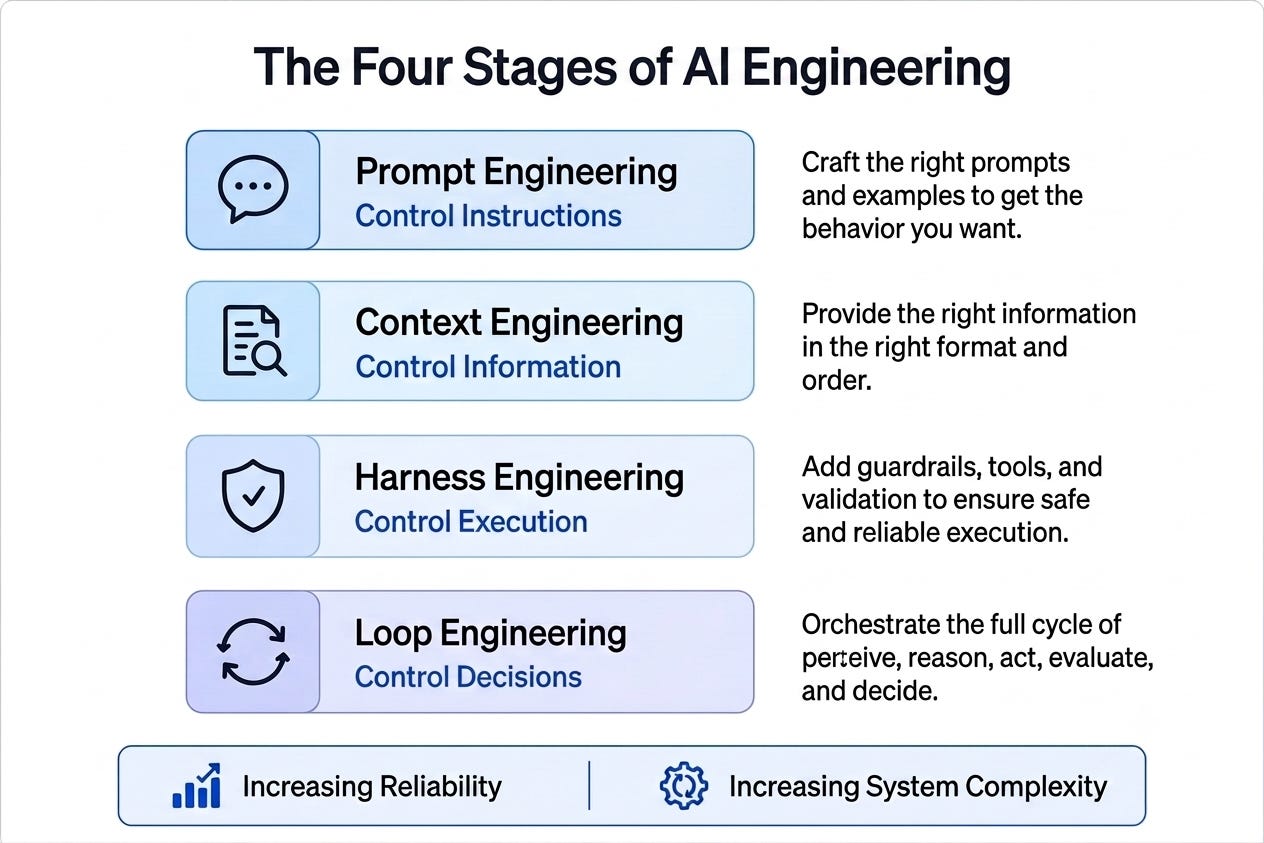
So you added layers. First, retrieval - feed the agent customer order history and product data. That helped, but the agent still hallucinated based on bad context. Then, verification - make it call tools instead of guessing, validate refunds before approval, log every decision. Better, but the agent still didn’t know when to escalate versus when to retry. So you added orchestration - define a clear loop: perceive the ticket, reason about the issue, act on a decision, evaluate whether it worked. Only then does it escalate or close.
Each layer solved an immediate failure. Each one forced you to think differently about the system. What you were doing, without realizing it, was moving through the four stages of AI system maturity.
The Pattern: AI Engineering is the Evolution of Control
AI systems don’t evolve smoothly. They evolve in discrete jumps, each prompted by a limitation you hit in production. And each jump represents the same underlying progression: expanding control.
Stage 1 Control Instructions
Shape the model’s behavior through prompts.Stage 2 Control Information
Decide what knowledge reaches the model.Stage 3 Control Execution
Control how the system validates and acts.Stage 4 Control Decisions
Orchestrate what the system attempts, retries, or escalates.
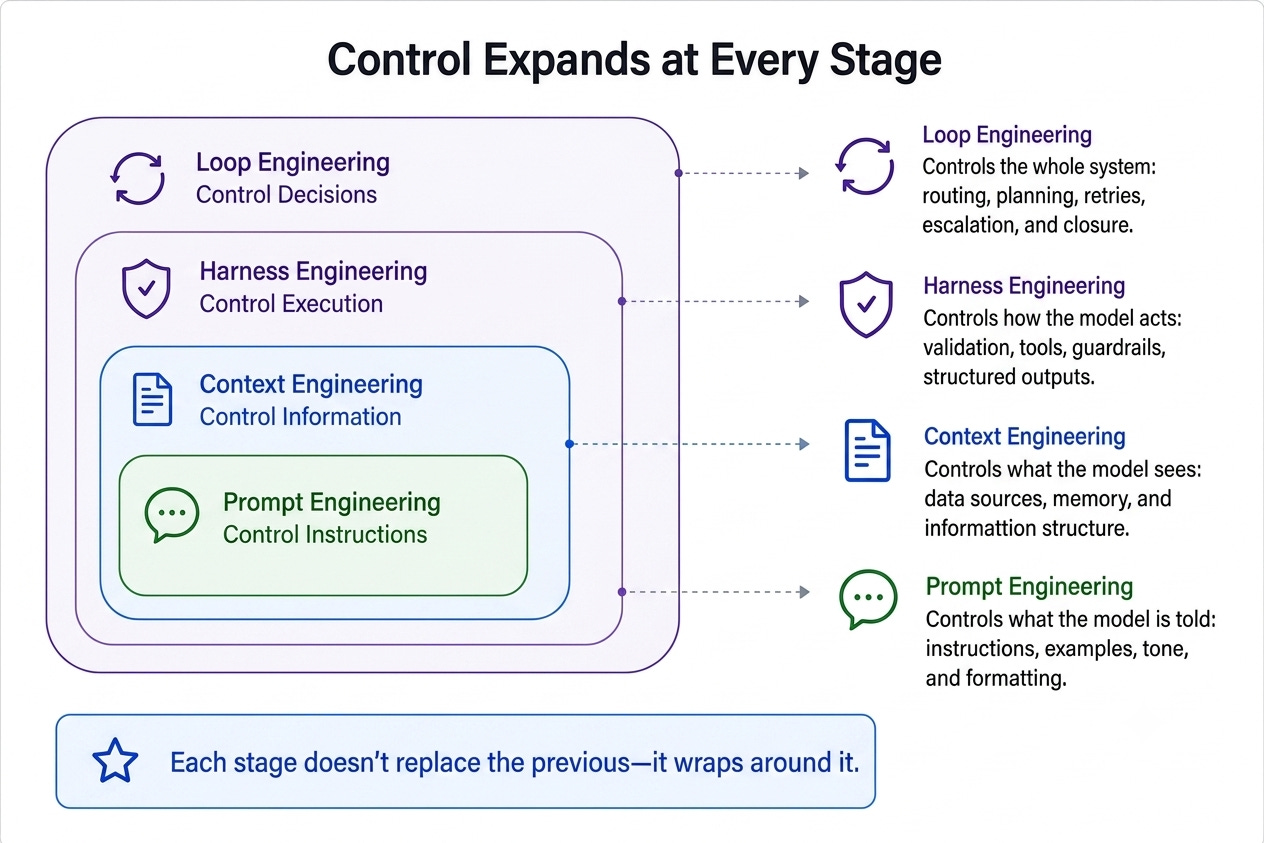
Each stage assumes the previous one is “solved” or at least no longer the bottleneck. And each stage makes the system more reliable, but also more complex. This progression isn’t arbitrary. It’s the natural evolution from controlling language to controlling the entire system’s behavior.
Where It All Starts: Prompt Engineering
You begin here. The model is fixed (Claude, GPT, Llama doesn’t matter for this frame). The only variable is the text you send in.
Prompt engineering is about finding the right words, structure, and examples to trigger the behavior you want. A well-crafted prompt can clarify ambiguous instructions, provide in-context examples, set tone, and break complex tasks into steps. The wins are real. A good prompt can double accuracy on a benchmark. A bad prompt can tank it.
Yet words alone have limits. You can’t prompt your way out of missing data. You can’t reword your way around a context window too small to hold the relevant information. No amount of instruction clarity fixes a model that hallucinates because it’s working blind.
At this ceiling, the problem shifts from “how do I phrase this” to “what should the model even know about.”
Moving Right: Context Engineering
Context engineering answers: “What data should reach the model, and in what order?”
This is where Retrieval Augmented Generation lives. RAG lets you feed the model live data it wasn’t trained on. A customer service agent retrieves the customer’s account history. A medical system retrieves the patient’s lab results. An earnings analyst retrieves the quarterly filing.
But retrieval is just one tool. Context engineering also means deciding:
Structure: Should you embed retrieved data directly, summarize it, or format it as JSON or Markdown?
Token budgeting: What gets in the context window? What stays out? In what order?
Memory architecture: Working memory (what happened this conversation), episodic memory (similar past cases), semantic memory (knowledge base facts), procedural memory (how to do things).
Here’s where context engineering reaches its own wall: more information doesn’t fix a confused reasoner. When the model gets lost in the data or refuses to follow instructions even with perfect context, you’ve outgrown what retrieval can solve.
The next step isn’t better data. It’s better control over what the model does with that data.
Going Deeper: Harness Engineering
Harness engineering is about building the guardrails.
What is harness engineering? If prompts tell the model what to do, harness engineering determines what happens when the model is wrong. It’s the discipline of designing the systems, tools, constraints, and feedback loops that wrap around the model to transform it from a probabilistic component into reliable software. Think of it like the difference between having a talented chef and running a restaurant: the chef handles creativity, but the kitchen systems (timers, scales, temperature controls, quality checks) turn talent into consistency.
The principle: you know the model will sometimes fail. You can’t make it never fail. So instead, you catch failures and route around them.
A concrete example: A customer support agent handles thousands of tickets daily. Without harness engineering, it hallucinates product features the company doesn’t offer, approves refunds without checking if the customer’s account is eligible, and gets stuck retrying the same failing action. With harness engineering, the system adds five layers around the model:
Tool sandboxing - The agent can call customer database, order lookup, and refund APIs, but cannot access other customers’ data or modify account settings
Verification loops - Before approving a refund, the harness checks: Is this customer eligible? Is the account in good standing? Is the refund amount within policy? If any check fails, the recommendation is rejected
Memory - The agent recalls similar past interactions. Was this customer refunded before for the same issue? This prevents repeated mistakes
Guardrails - Refund amounts are capped at $X per interaction. Only certain issue types can be auto-resolved; others auto-escalate by policy
Observability - Every decision is logged: customer ID, issue type, action taken, outcome. Dashboards show resolution rate, escalation rate, refund leakage
The result: The agent handles 80% of tickets without human escalation. The 20% that need human attention are pre-qualified and routed with full context.
The toolkit that enables this:
Output validation: Parse the response. Check if it’s valid JSON, matches the schema, contains the required fields. If not, reject and retry.
Tool use: Don’t let the model do math or look up facts make it call a tool. You control the tool’s output; you don’t control the model’s reasoning, but you control what it can do.
Structured outputs: Force the model into a strict format (JSON, XML) so downstream systems know exactly what to expect.
Verification: After the model answers, check it independently. A search engine might verify a factual claim. A refund system might verify the customer’s account eligibility.
Rollback and retry: If validation fails, regenerate with modified instructions.
The ceiling here is operational. Harness engineering can make the system more reliable, but it doesn’t solve “the model shouldn’t be trying this task at all” or “we need to decide what priority to give this request.” If a task is inherently hard (the model fails 40% of the time even with perfect guardrails), you’re not automating it you’re adding complexity without reducing failure rate. And if you’ve built a system that blindly retries every failure, you’ll burn tokens: 1,000 extra tokens per request, at scale, becomes a cost problem.
When you hit that ceiling, you add logic that decides whether the model should try a task, and what to do if it fails.
At Scale: Loop Engineering
Loop engineering is about orchestration and control flow.
What is loop engineering? It’s the discipline of orchestrating how an AI system executes iteratively designing the perceive-reason-act-reflect cycle, defining what success looks like, and deciding when to retry versus when to escalate. The “loop” is the repeating cycle that keeps the system pointed at its goal.
A concrete example: A customer support agent processes tickets as they arrive. When a customer emails, the agent perceives the issue, reasons about the root cause, retrieves relevant data, acts on a response, and evaluates: “Did this resolve it? Should this escalate?” Clear stop conditions. No infinite loops. No blind escalation.
Without loop engineering, the agent retries infinitely or escalates everything. With loop engineering, it has explicit boundaries: one perceive-reason-act-evaluate cycle with clear success criteria.
The key questions the loop continuously asks:
What should happen next? (routing, prioritization)
Is the model the right tool for this? (or should we use a heuristic, escalate, or fail gracefully)
Did it work? (outcome evaluation)
What’s next? (retry, escalate, or close)
The ceiling here is complexity. Well-designed loops handle many failure modes. But more branches mean harder debugging, and multiple loops can interfere with each other in unexpected ways.
What Actually Breaks in Production
Here’s what happens when engineers try to stay in an earlier stage longer than they should:
Prompt engineering as a panacea: Teams spend weeks tuning prompts with diminishing returns. “Add more examples.” “Clarify the instruction.” These work until they don’t. The trap: assuming the next 10% accuracy improvement is one prompt rewrite away, when in reality you need context engineering or harness engineering. In customer support, this looks like: tweaking the system prompt to “never make refund mistakes” when the real problem is that the agent has no tool to check customer eligibility. More wording doesn’t help. Guardrails do.
Retrieval without validation: RAG systems that fetch data and feed it to the model without checking whether the data is relevant or accurate. The model hallucinates based on bad context. The team assumes the problem is in retrieval and adds sophisticated chunking, reranking, hybrid search. Meanwhile, the real problem is that the model needs validation guardrails to catch when it’s confused by the fetched data. In customer support: you fetch the customer’s order history, but don’t verify that the order status has actually been updated before the agent references it. The agent then gives a customer stale information. More retrieval doesn’t fix this. Validation does.
Over-reliance on retries: Teams add retry logic to harness problems they can’t otherwise solve. “If validation fails, regenerate 3 times.” This increases latency and token consumption without proportionally increasing reliability. Often, the real fix is loop engineering deciding not to try certain requests, or routing them to a different system. In customer support: if a refund is rejected (customer ineligible), retrying won’t help. The agent needs to escalate instead. Blindly retrying burns tokens and frustrates the customer.
Harness without loop structure: A customer support system with perfect tool sandboxing, verification, and observability but no defined loop. The agent resolves some tickets perfectly, but gets stuck in others. Nobody knows when it should escalate. It retries the same action infinitely. It sends responses but doesn’t track whether they’re working. The lesson: harness engineering builds the safety rails, but loop engineering builds the execution structure. Without a defined loop (perceive-reason-act-evaluate, with explicit stop conditions), even the best harness can’t scale. You end up with a safe system that doesn’t work reliably.
Why This Matters
The biggest mistake teams make isn’t choosing the wrong model.
It’s solving a Stage 3 problem with Stage 1 techniques.
Most production failures aren’t model failures they’re architecture failures. Your LLM didn’t get stupid. Your system didn’t match the problem. Understanding which stage you’ve reached is often more valuable than finding a better prompt.
When your agent hallucinates, that’s not always a prompt problem. When it makes inconsistent decisions, that’s not always a model problem. When it costs too much, that’s not always a compute problem.
These are architecture problems. And architecture problems require architectural solutions.
Every engineering decision is ultimately a trade-off. Regardless of the stage you're in, production AI systems are constrained by three forces: Cost, Quality, and Latency.
CQL Lens
Cost : Each stage adds latency and/or token consumption. Prompt engineering is cheapest (extra tokens only if you add examples). Context engineering adds retrieval calls and context window overhead. Harness engineering adds validation and retry passes (2–5x the base latency per retry). Loop engineering adds orchestration overhead but can reduce cost by choosing not to call the model when a simpler path works. The question isn’t “which stage is cheapest” but “which stage is efficient for your problem.” A task that needs harness engineering stays cheap because harness catches errors early. A task that only needs prompts but you force into full harness bloats the cost.
Quality :Moving through stages improves reliability in order. Prompt engineering improves consistency. Context engineering improves accuracy on knowledge tasks. Harness engineering improves robustness to edge cases and adversarial inputs. Loop engineering improves system-level reliability by knowing when to escalate, when to fail gracefully, when to try something else. But quality degrades if you over-engineer too many retries, too many guardrails, latency increases, and slow systems fail differently than fast systems.
Latency Prompt engineering adds minimal latency (a few extra tokens). Context engineering adds retrieval time. Harness engineering adds validation and retry time. Loop engineering adds orchestration time but can reduce latency by choosing not to call the model. The trap: adding full loop engineering to a system that only needs prompts or context, just to feel “advanced.” Maturity is matching the stage to the problem, not using every stage.
What’s Next?
The Anatomy of a Production AI System
Every production AI system is built from the same fundamental components. In the next chapter, we'll break down prompts, models, context, memory, tools, guardrails, and orchestration and see how they fit together into a production-ready AI system.
One thing this framework makes clear is that reliability isn't in the model, it's in the system. Once you reach Stage 3 or 4, surrounding architecture has a bigger impact than the LLM you're using